
Marketing Automation vs. Manual Marketing: Which One Drives More Growth?
Discover the key differences between manual marketing and marketing automation. Learn why automation drives scalable growth, consistency, and speed without replacing human creativity.

Introduction
Most businesses don't fail because they lack good marketing ideas. They fail because execution quietly becomes the bottleneck.
Campaigns are brainstormed. Creatives get approved. Ads go live. Leads start flowing in. On paper, everything looks right. Yet growth feels slower than it should. Teams are busy, calendars are packed, dashboards show activity, but momentum stalls. The issue isn't effort. It's the system behind that effort.
This is where the real debate begins: marketing automation vs manual marketing.
Manual marketing feels safe because it's familiar. You can see the work happening, posts being scheduled, messages being sent, follow-ups being typed. It creates the illusion of control. Marketing automation, on the other hand, feels powerful but intimidating. Too technical. Too complex. Too risky, at least on the surface.
But growth doesn't reward comfort. It rewards speed, consistency, and scale.
And that's exactly where manual execution starts to crack. At first, manual marketing works. When volumes are low and expectations are manageable, human-driven execution feels efficient. But as growth kicks in, the cracks appear. Replies slow down. Campaign follow-ups slip. Leads go cold before anyone responds. Performance becomes inconsistent, not because the strategy is wrong, but because humans can't execute perfectly at scale.
Manual marketing quietly turns into a liability. You become dependent on memory, spreadsheets, tool switching, and people never missing a step. And the moment someone is busy, distracted, or unavailable, the system breaks.
Marketing automation, when done right, replaces memory with logic. Effort with systems. Chaos with repeatable workflows that run in the background, triggering campaigns, routing leads, sending follow-ups, and maintaining consistency without constant supervision. This isn't about replacing teams. It's about freeing them from bottlenecks. Because in the long run, growth doesn't ask how hard you worked today. It asks whether your system can perform tomorrow, again, and again, and again.
What Manual Marketing Really Looks Like (Beyond the Ideal Version)
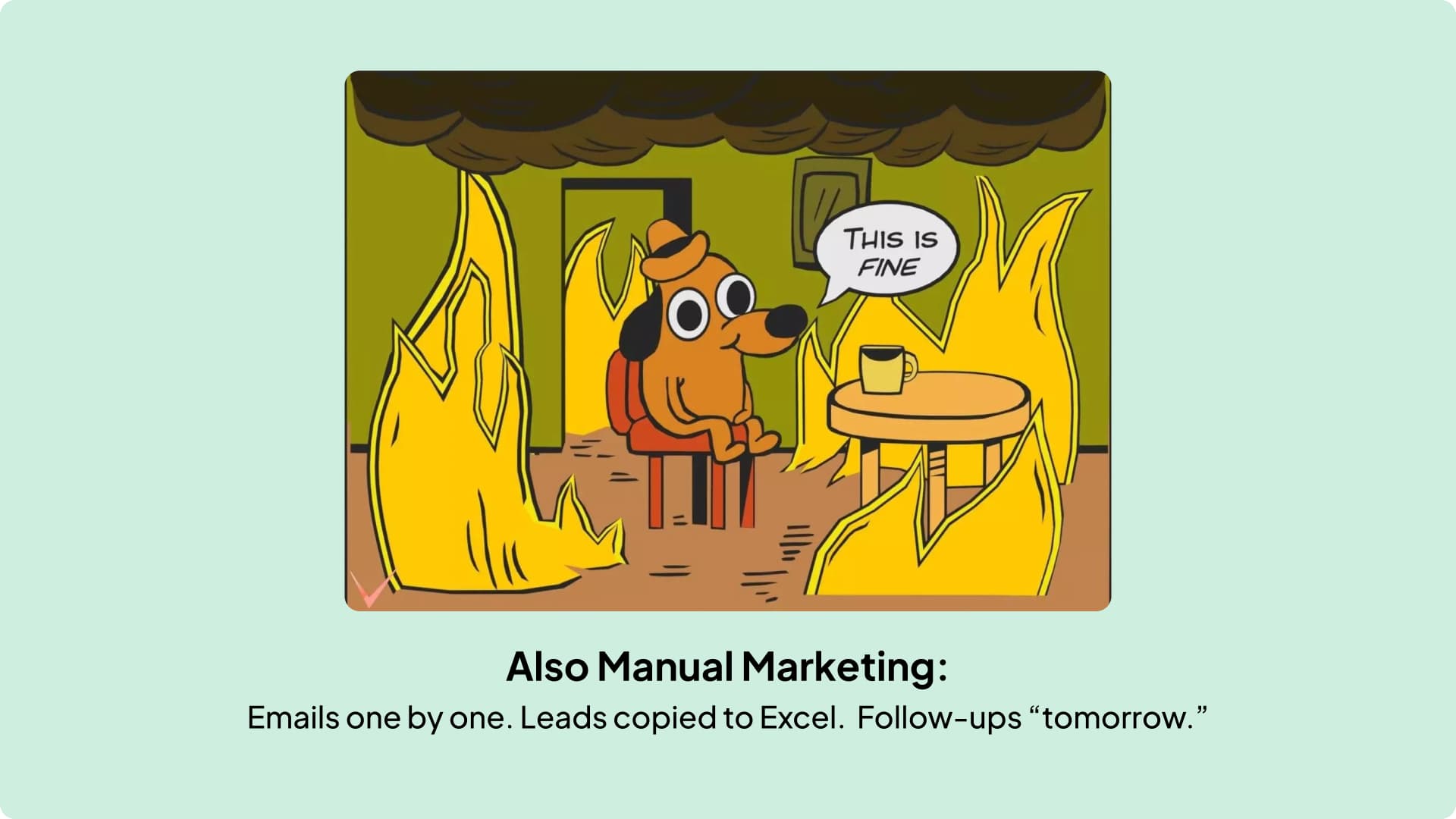
Manual marketing is where almost every business begins. It feels hands-on, personal, and reassuringly controllable. You write the emails yourself. You post content manually. You follow up with leads when you remember. You update spreadsheets. You check performance across tools. At small volumes, this approach works, and that's exactly why so many teams stay stuck in it longer than they should.
The problem is that most businesses judge manual marketing by how it performs in its early stages, not by how it behaves under pressure. When message volume is low and channels are limited, human-driven execution feels efficient. But as growth accelerates, manual processes start to break, not due to lack of effort, but because repetitive marketing execution doesn't scale with people.
In reality, manual marketing looks like:
- Sending emails or WhatsApp messages one by one.
- Posting on social media manually across multiple platforms.
- Copy-pasting leads into CRMs or spreadsheets.
- Following up "when someone gets time."
- Pulling reports manually from different marketing tools.
Each task seems small. But combined, they create friction, delays, and inconsistency. Response times stretch. Follow-ups slip. Leads cool off. Reporting becomes reactive instead of strategic. Manual marketing doesn't fail loudly. It fails quietly, by slowing momentum, exhausting teams, and capping growth long before demand runs out.
The Real Limitations of Manual Marketing
Manual marketing rarely collapses overnight. Instead, it erodes performance in small, invisible ways that compound over time. What starts as a manageable workload slowly turns into operational drag. Campaign timelines stretch. Lead responses lose urgency. Social content goes live when attention has already moved on. Reporting turns into a rear-view mirror instead of a steering wheel. None of this triggers alarm bells immediately, but together, they steadily dilute impact.
The deeper issue with manual marketing execution is that outcomes become tied to individual stamina rather than process reliability. Growth depends on who remembered what, who followed up on time, and who didn't miss a step on a busy day. That's not a growth model, it's a risk model.
As volume increases, new problems emerge:
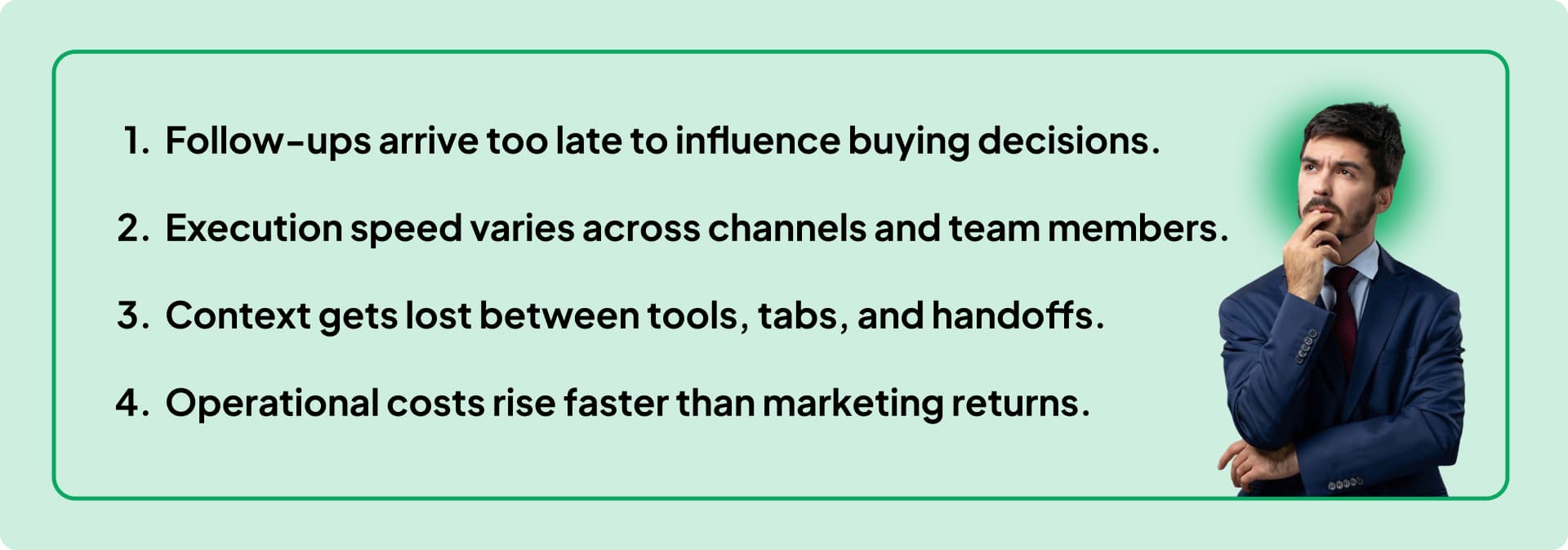
- Response times become inconsistent.
- Critical follow-ups slip through cracks.
- Team members duplicate work without realizing it.
- Campaign timing gets pushed to "when someone has capacity."
- Lead quality deteriorates because nurturing isn't systematic.
- Reporting becomes a scramble to piece together data from multiple tools.
- Scaling requires hiring more people instead of improving systems.
Scaling under these conditions becomes expensive and unpredictable. Every new campaign adds complexity. Every new channel adds friction. Instead of compounding results, effort fragments across tasks. This is the silent ceiling of manual marketing. Not a lack of ideas. Not a lack of demand. But a system that can't maintain precision, timing, and continuity as pressure increases.
At scale, growth doesn't slow because ambition fades. It slows because manual execution can't carry momentum forward consistently.
What Marketing Automation Actually Means (Not the Buzzword Version)
Marketing automation, by definition, is the use of software and technology to automatically execute marketing actions based on customer behavior, predefined rules, and real-time triggers, without requiring manual effort at every step. It's not a trend or a shortcut. It's a structural shift in how modern businesses operate. And most importantly, marketing automation is not about removing humans from marketing. It's about removing humans from the repetitive, error-prone execution that slows growth. Automation doesn't replace thinking. It replaces waiting.
In manual marketing, progress depends on availability. Someone has to notice a lead, remember to follow up, copy details into a CRM, send a message, and then check again later. Each step introduces delay. With marketing automation platforms like Quick Hub, actions happen the moment behavior happens, no reminders, no follow-ups falling through the cracks.
What Marketing Automation Looks Like in Practice
Let's take a simple, real-world example. A customer clicks a Facebook ad and sends a WhatsApp message asking for pricing.
Manual marketing flow:
- The message sits unread for 20–30 minutes.
- A team member replies with basic details.
- The lead is copied into a spreadsheet or CRM later.
- Follow-up happens "if someone remembers."
- The customer loses interest or messages a competitor.
Automated marketing flow with Quick Hub:
- The WhatsApp message triggers an automated reply instantly.
- A WhatsApp bot responds with pricing, common answers, and quick reply options—without manual effort.
- The lead is automatically captured inside Quick CRM.
- No reply? A gentle automated follow-up goes out after 24 hours.
- If they engage, the workflow routes them to a human or triggers a Quick Campaign via WhatsApp, SMS, or email.
- No delays. No missed steps. No dependency on memory. That's behavior-based marketing automation in action.
What Marketing Automation Really Is
Automation works when systems run the marketing — not manual blasts. It focuses on:
- Triggered workflows, not mass messaging.
- Personalized automation, not generic campaigns.
- Multi-channel automation that connects WhatsApp, email, SMS, social media, and ads.
- Always-on execution, not office-hour marketing.
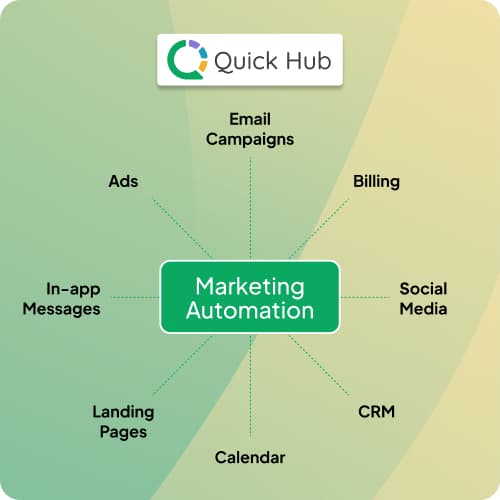
With tools like Quick Hub, automation connects conversations, campaigns, reviews, ads, CRM, and workflows into one unified engine. Every customer action triggers the next best action automatically.
Why Marketing Automation Enables Scalable Growth
Humans are great at strategy, creativity, and decision-making. But they're terrible at repeating the same task perfectly 1,000 times. If your marketing still depends on memory and manual effort, survival is already at risk. Automation ensures:
- Every lead gets an instant response.
- Every customer journey is consistent.
- Every campaign runs on time.
- Every follow-up happens automatically.
Marketing automation doesn't make your marketing impersonal. It makes your execution reliable. And when execution becomes reliable, growth becomes predictable. That's the real meaning of marketing automation, not hype, not buzzwords, but systems that perform again, and again, and again.
Marketing Automation Examples That Actually Matter
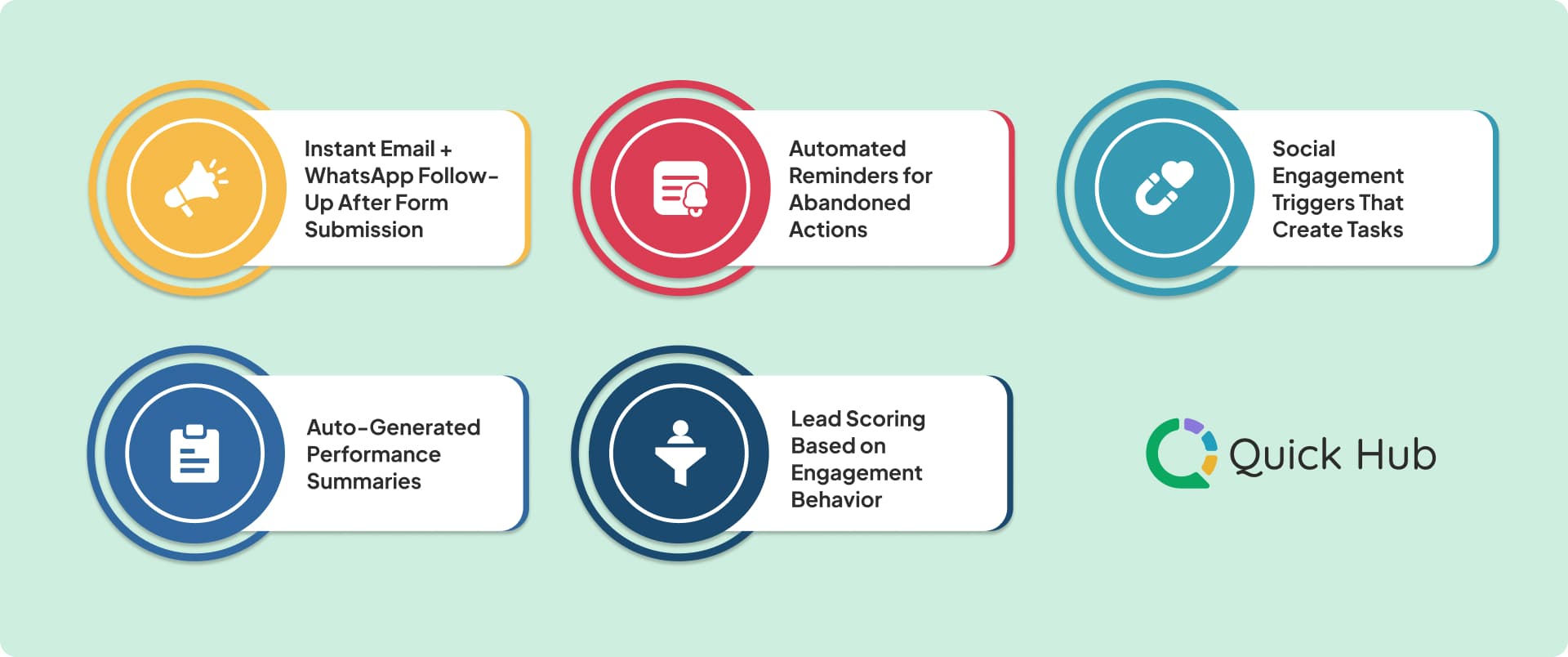
The most effective marketing automation examples are rarely flashy. They don't announce themselves. They simply work, quietly eliminating delays, reducing drop-offs, and making sure no opportunity slips through the cracks. Great automation isn't about showing off technology; it's about removing friction from the customer journey and operational stress from the team.
When automation is implemented correctly, teams stop asking "Did we follow up?" because the system already handled it. This is where automated marketing campaigns consistently outperform manual execution, through speed, accuracy, and repeatability.
Below are automation workflows that directly impact growth, engagement, and team efficiency.
1. Instant Email + WhatsApp Follow-Up After Form Submission
The moment a lead fills out a form, timing becomes everything. With lead automation workflows, an instant email confirmation and WhatsApp message are triggered automatically. This immediate response increases conversion rates, improves lead quality, and creates trust while interest is still high. No waiting. No manual handoff. Just instant engagement powered by multi-channel marketing automation.
2. Automated Reminders for Abandoned Actions
Whether it's an incomplete signup, an unfinished checkout, or a missed reply, abandonment is a silent revenue leak. Automated reminder campaigns re-engage users at the right moment with relevant nudges across email, WhatsApp, or SMS — without feeling spammy. This is a core example of behavior-based marketing automation driving recovery.
3. Social Engagement Triggers That Create Tasks
When someone comments, reacts, or sends a DM, automation ensures it doesn't get lost. Social media automation workflows can instantly create tasks, notify sales teams, or trigger responses inside a CRM. This bridges the gap between engagement and action, turning attention into pipeline, automatically.
4. Auto-Generated Performance Summaries
Manual reporting kills momentum. With marketing automation software, performance summaries are generated automatically, pulling data from campaigns, ads, and social channels. Teams get real-time visibility without chasing dashboards, enabling faster decisions and better optimization.
5. Lead Scoring Based on Engagement Behavior
Not all leads are equal. Automated lead scoring evaluates actions, opens, clicks, replies, visits, and assigns value automatically. High-intent leads move quickly through the funnel, while low-intent leads are nurtured with automated workflows until they're ready to convert.
These examples matter because they don't just save time, they protect revenue, increase consistency, and make growth predictable. That's the true power of marketing automation done right.
Where Marketing Automation Drives Measurable Growth
Marketing automation doesn't just make teams more efficient, it fundamentally changes how growth is created and sustained. Instead of relying on constant manual effort, businesses shift to scalable marketing systems that compound results over time. This is why companies investing in digital marketing automation platforms don't just grow faster, they grow more predictably.
When automation is in place, growth stops being reactive. Lead handling becomes structured. Follow-ups become guaranteed. Campaigns perform consistently instead of depending on who executed them that day. The impact shows up clearly across the funnel: higher conversion rates, improved lead quality, shorter sales cycles, and lower operational stress.
What automation really does is remove friction between intent and action. When a customer shows interest, the system responds instantly. When engagement increases, the system adapts. When volume spikes, the system doesn't break. That's how automation stabilizes growth, and then accelerates it.
Key growth multipliers unlocked by marketing automation:
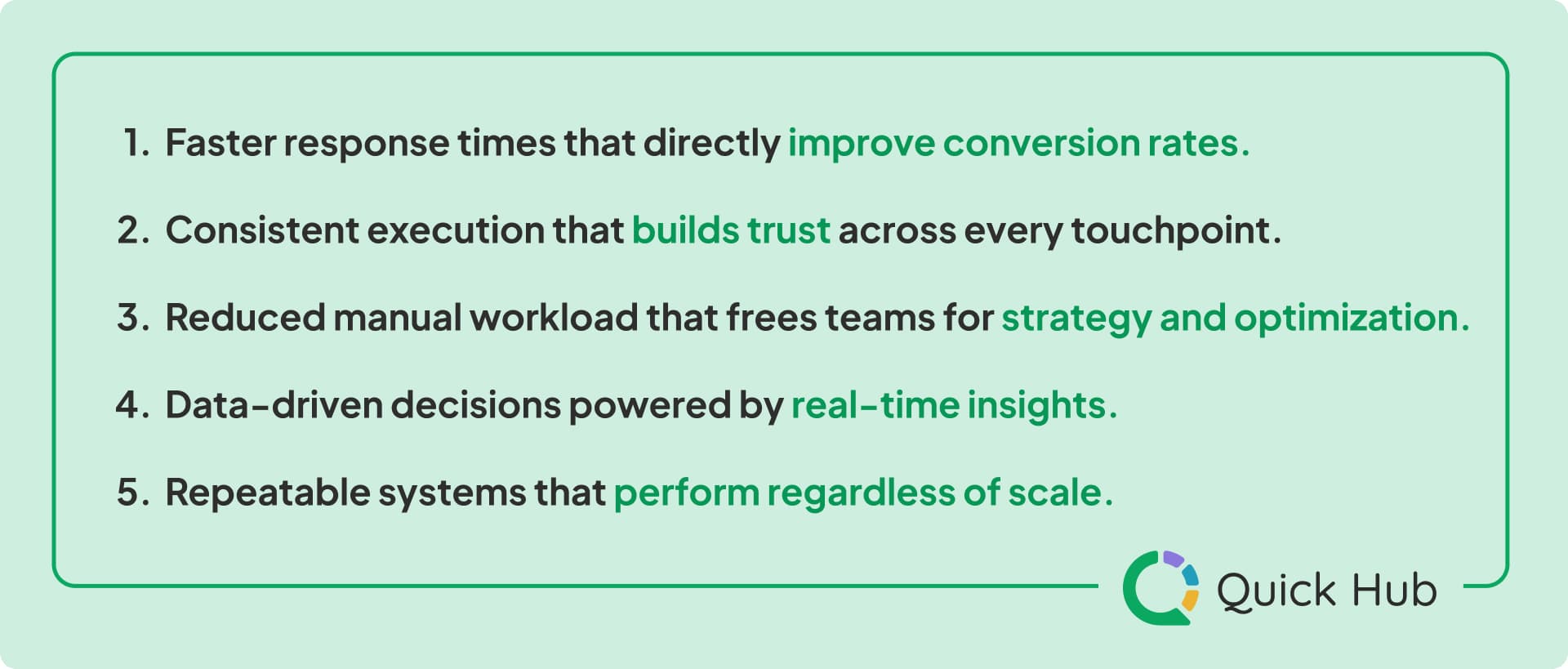
- Faster lead conversion through instant responses
- Higher engagement rates from timely, relevant messaging
- Better lead quality through behavioral scoring
- More predictable revenue from consistent execution
- Lower operational costs by reducing manual overhead
- Reliable scaling without hiring proportionally
Automation doesn't replace growth strategy. It amplifies it.
Speed: Why Automation Always Wins
Speed is one of the most undervalued competitive advantages in modern marketing. The gap between a reply and silence is often the gap between conversion and churn. Manual marketing is constrained by working hours, human focus, and availability. Automation removes all of those limits instantly.
With marketing automation tools like Quick Hub, lead responses, notifications, and follow-ups happen in real time. There's no waiting for someone to notice a new form submission. No delay caused by handoffs between teams. No backlog of messages piling up during peak hours or weekends.
Automation ensures that when intent is highest, engagement is immediate. And that speed compounds across every channel, email, WhatsApp, social, ads, and CRM workflows.
Speed advantages of automated marketing systems:
- Instant lead responses that prevent drop-offs.
- Real-time engagement across messaging and social channels.
- Automated follow-ups triggered by behavior, not schedules.
- Zero dependency on team availability or time zones.
- Faster movement from interest to action.
In competitive markets, speed isn't a bonus, it's the baseline. Automation ensures you never lose deals simply because you were slow.
Consistency: The Difference Between Effort and Systems
Manual marketing often looks effective on the surface, but consistency is where it quietly breaks down. People forget. Priorities shift. Follow-ups get delayed. Messages vary in tone. Execution quality depends on who's handling the task that day. Over time, this inconsistency erodes trust and performance.
Marketing automation replaces human memory with reliable, repeatable systems. Every lead receives the same timely response. Every campaign follows the same logic. Every workflow runs exactly as designed, no shortcuts, no gaps.
This consistency is what transforms marketing from a series of isolated actions into a cohesive customer journey. Instead of hoping execution goes right, businesses can guarantee it.
Consistency benefits of marketing automation:
- Zero missed follow-ups across channels.
- Uniform messaging and brand experience.
- Predictable execution regardless of volume.
- Reduced reliance on individual discipline.
- Stronger trust built through reliable communication.
Effort creates activity. Systems create outcomes. Automation is the system that keeps marketing performing, even when teams are stretched.
Scale: Growth Without Linear Effort
Manual marketing scales in the most expensive way possible, by adding people. More leads require more follow-ups. More campaigns need more execution. More channels demand more coordination. Growth becomes tied directly to headcount, making it fragile, costly, and hard to sustain.
Marketing automation breaks this linear relationship. With scalable marketing automation software, volume can increase dramatically without increasing workload at the same rate. A single automated workflow can handle hundreds, or thousands of interactions simultaneously with the same precision. This is why marketing automation for scaling businesses isn't a nice-to-have. It's the foundation that allows growth without chaos.
Scale advantages of automated marketing platforms:
- Handle 10x lead volume with the same team size.
- Reduce dependency on individual performance.
- Maintain execution quality as demand grows.
- Enable expansion across channels without complexity.
- Make growth predictable, repeatable, and controllable.
At scale, hustle fails. Systems win. Marketing automation is what allows businesses to grow bigger without becoming slower, messier, or more fragile.
Manual Marketing vs Marketing Automation: A Clear Comparison

When businesses compare manual marketing vs marketing automation, the difference isn't about preference or philosophy, it's about structure. Manual marketing depends heavily on human effort, availability, and discipline. Marketing automation depends on systems, logic, and repeatable workflows. And at scale, structure always outperforms effort.
Manual marketing operates in a reactive mode. Tasks get done when someone has time. Responses depend on working hours. Follow-ups rely on memory or reminders. Even with a talented team, execution quality fluctuates because people are juggling multiple priorities across channels. This makes manual marketing unpredictable, resource-intensive, and increasingly fragile as volume grows.
Marketing automation, on the other hand, is proactive by design. Actions are triggered by behavior, not by someone remembering to act. When a lead engages, the system responds instantly. When conditions are met, workflows execute automatically. The result is consistent, real-time execution across email marketing automation, WhatsApp automation, CRM workflows, and campaign management.
Manual marketing characteristics:
- Effort-driven execution dependent on individuals.
- Slower response times during peak volume.
- Inconsistent results across campaigns and channels.
- Scaling requires proportional hiring and oversight.
Marketing automation characteristics:
- System-driven marketing workflows.
- Instant, behavior-based responses.
- Consistent execution across every touchpoint.
- Predictable scaling without linear effort.
This is why the debate of marketing automation vs traditional marketing becomes one-sided at the growth stage. When speed, consistency, and scalability matter, automation isn't just more efficient, it's structurally superior.
The Myth That Stops Adoption: "Automation Kills Personalization"
One of the biggest fears around automation is loss of personalization. Ironically, the opposite is true. Manual marketing becomes generic under pressure. Automation enables relevance at scale.
With marketing automation workflows, messages adapt to user behavior, not assumptions. Personalization becomes data-driven, not memory-based. Automation improves personalization by responding to real actions, timing messages perfectly, and matching channels to context.
How Marketing Automation Improves ROI
Marketing automation improves ROI not by doing more marketing, but by eliminating waste inside the funnel. In manual marketing, revenue leaks happen quietly: slow responses, forgotten follow-ups, inconsistent nurturing, and unclear attribution. Individually, these issues feel small. Collectively, they erode conversion rates and inflate acquisition costs.
With marketing automation, every lead is handled at the moment of highest intent. Automated follow-ups ensure no prospect slips through the cracks. Email marketing automation, WhatsApp automation, and CRM workflows respond instantly, nurturing leads while interest is still fresh. This speed alone has a direct impact on ROI, because faster responses consistently lead to higher conversions.
Automation also improves ROI by qualifying leads before human time is invested. Through lead scoring, behavior-based triggers, and automated journeys, only high-intent leads reach sales teams. This reduces wasted effort and shortens sales cycles. At the same time, automation creates clearer attribution. You know which campaigns, messages, and touchpoints actually drive results, making optimization data-driven instead of guess-based.
ROI gains come from:
- Automated lead follow-ups at scale.
- Higher-quality leads through behavior tracking.
- Reduced response delays across channels.
- Clear attribution across automated marketing campaigns.
In short, marketing automation turns effort into efficiency, and efficiency into measurable returns.
Automation Is a Multiplier, Not a Replacement
The real conversation isn't marketing automation vs manual marketing. It's how the two work together. Automation doesn't replace marketers, no, instead it removes the friction that prevents them from doing their best work.
Humans are exceptional at strategy, creativity, storytelling, and decision-making. But humans are terrible at repetitive execution at scale. That's where automation belongs. Marketing automation tools take over execution-heavy tasks, sending follow-ups, triggering campaigns, maintaining consistency, so teams can focus on growth-driving work.
The most successful businesses don't automate everything. They automate the repeatable, predictable tasks and keep humans in control of direction and insight.
The right division of roles looks like this:
- Humans: strategy, creative direction, analysis, and optimization.
- Automation: execution, consistency, speed, and scale.
When automation and human intelligence work together, marketing stops being reactive, and starts becoming a scalable, ROI-positive growth system.
Final Verdict: Marketing Automation vs Manual Marketing
Manual marketing helps you start. Marketing automation helps you scale.
Manual marketing is pushing the car, hands on the hood, full effort, limited distance. It works when momentum is low and volume is manageable. But the moment growth accelerates, pushing harder stops working. Automation is installing the engine. It doesn't just move faster, it moves consistently, predictably, and without burnout.
With a unified marketing automation platform for small businesses like Quick Hub, growth stops depending on who remembered to follow up, who had time to respond, or which tool was open at the moment. Campaigns execute automatically. Leads are nurtured instantly. Conversations flow across WhatsApp automation, email marketing automation, CRM workflows, social scheduling, ads, reviews, and AI agents, all inside one connected system.
This is the real shift:
- Manual marketing relies on effort.
- Marketing automation relies on systems.
- Systems don't get tired, distracted, or inconsistent.
Final truth:
- Effort creates momentum.
- Systems sustain growth.
- And growth always chooses systems in the long run.
If manual marketing got you here, marketing automation is what takes you forward, faster, smarter, and at scale.
Wrap-up
Marketing automation shouldn't be complicated. QuickHub is designed to fit seamlessly into your workflow — whether you're nurturing leads, managing customer relationships, or launching campaigns on the fly.
If that sounds like the kind of platform you need — try QuickHub free today. No credit card required, and you can be up and running in minutes.
Related Resources
Stay Updated
Get the latest tips and updates delivered to your inbox.